
In 1913, the first large exhibition of modern art in the United States was held at the New York City’s 69th Regiment Armory. Organized by the Association of American Painters and Sculptors, the 1913 Armory Show, as it is now commonly known, introduced American artists and the art-viewing public, who had been accustomed to a realistic style of art, to the experimental styles of the European avant-garde, including artists like Picasso, Matisse, Duchamp, and more. Much publicity and buzz was generated about and around this show and most of it was hostile. News reports and reviews were filled with accusations of quackery, immorality, and anarchy. The 1913 Armory show was lampooned through many parodies, caricatures, and mock exhibitions in the U.S.1,2

Marcel Duchamp’s “Nude Descending a Staircase, No. 2” would become the most infamous work from the show (top right). Today, it is widely regarded as a Modernist classic, but it was the subject of much criticism and ridicule when it was first exhibited here in the U.S., solidifying Duchamp’s reputation as an artistic provocateur.3 Some compared it to an explosion in a “shingle factory”.4
One such parody of Duchamp’s painting was published in the New York Evening Sun on March 20, 1913 and signed by a J. F. Griswold five days after the 1913 exhibition closed. The piece was entitled “The Rude Descending a Staircase (Rush Hour at the Subway)” and was part was part of a series in the Evening Sun titled “Seeing New York With a Cubist”. It is thought of as a model of the cacophony of modern life.5
Griswold’s piece has been reproduced and referenced in numerous books, periodicals, and websites over the years, but nobody has been able to determine the identify of J.F. Griswold or how their art was selected for this newspaper series. In 2017, a blogger named Alex Jay suggests that J.F. Griswold was likely Julia Frances Griswold, a New Jersey native who lived in Manhattan and worked as a teacher and artist from around 1910 until her death in 1931. Julia was the daughter of Warren Griswold (1845-1887), who was an Edward descendant.5
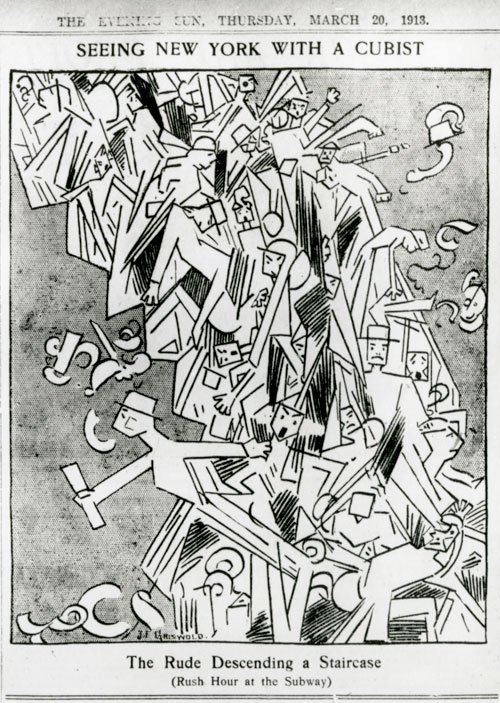
We’ll likely never definitively know the true identity of the artist behind this parody piece, but it’s interesting to wonder who it might have been and how their interpretation of Duchamp’s work influenced how modern art is seen today.
1https://hyperallergic.com/79951/vintage-comics-react-to-radical-1913-armory-show/
2https://hyperallergic.com/61890/scholar-unearths-two-long-lost-1913-armory-show-installation-photos/
3https://en.wikipedia.org/wiki/Armory_Show
4https://www.nytimes.com/1975/08/03/archives/explosion-in-a-shingle-factory.html
5https://alphabettenthletter.blogspot.com/2017/02/creator-j-f-griswold-rude-artist.html